

UCC search for lenders
Run a UCC lien search before you fund a business. Entitylight searches the state filing office for filings against the business, shows who holds a lien, and marks which filings are still active.
- UCC filings in 31 states and DC
- Secured parties, filing dates and lapse dates
- Active filings shown apart from lapsed ones
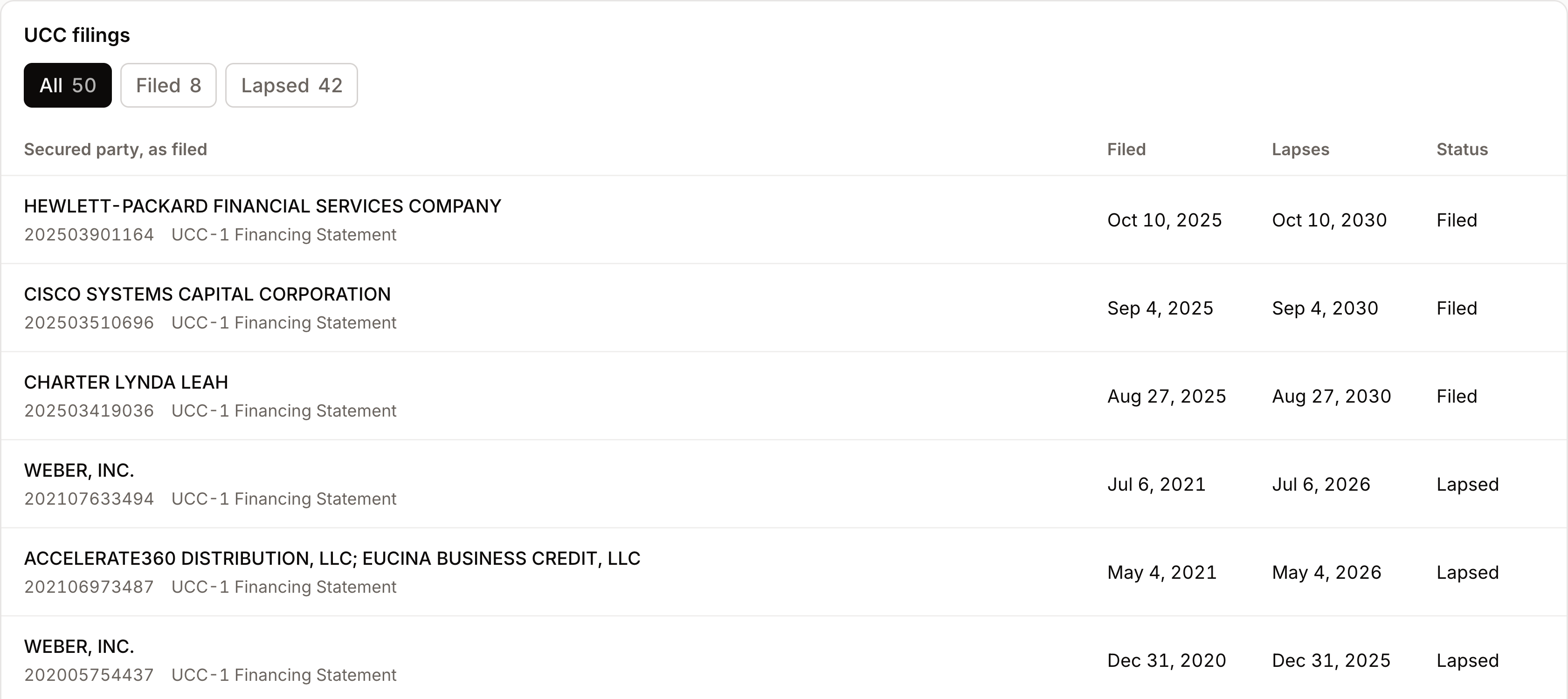
Sample data. Business and party names are made up.
What each UCC filing shows
- Secured party
- Who holds the lien, with the party's address for the newest 30 filings where the filing office shows it free.
- Filing type
- The kind of filing, such as a UCC-1 financing statement.
- Filing and lapse dates
- When the filing was made and when it lapses.
- Status
- Whether the filing is active or has lapsed, so a current claim is easy to tell from an old one.
- Filing image
- A link to the filing image where the filing office shows one free.
- Summary
- How many filings were read and how many are active.
Why lenders run a UCC lien search before funding
A UCC-1 financing statement is how another lender records a claim on a business's assets. A filing that covers all assets, filed by a party you do not know, changes what you are willing to fund.
Searching before you fund shows those claims while you can still act on them. After you fund, the same search can run on your schedule and flag a new filing against the business.
The same report also shows the business's state record and its court cases.
How a UCC search works
- 1
Search by business name and state
Run a full lookup, or a UCC search on its own by debtor name.
- 2
Entitylight searches the filing office
It searches the state filing office's own records, and the data Colorado and Connecticut publish. It keeps the filings whose debtor name matches the name you searched exactly.
- 3
Review the filings
Each filing is listed with its secured party, dates and status, next to the state record and court cases.
UCC coverage
UCC filings are searched in 31 states and DC. In any other state, the report shows UCC filings as not covered instead of empty.
- AK
- AL
- AR
- CA
- CO
- CT
- DC
- FL
- HI
- IA
- ID
- IL
- KY
- MD
- MI
- MS
- MT
- NC
- NJ
- NM
- NY
- OH
- OK
- OR
- PA
- RI
- SC
- TN
- VA
- VT
- WA
- WI
See every source on the data sources page.
UCC search by state
- Alabama UCC search
- Alaska UCC search
- Arkansas UCC search
- California UCC search
- Colorado UCC search
- Connecticut UCC search
- District of Columbia UCC search
- Florida UCC search
- Hawaii UCC search
- Idaho UCC search
- Illinois UCC search
- Iowa UCC search
- Kentucky UCC search
- Maryland UCC search
- Michigan UCC search
- Mississippi UCC search
- Montana UCC search
- New Jersey UCC search
- New Mexico UCC search
- New York UCC search
- North Carolina UCC search
- Ohio UCC search
- Oklahoma UCC search
- Oregon UCC search
- Pennsylvania UCC search
- Rhode Island UCC search
- South Carolina UCC search
- Tennessee UCC search
- Vermont UCC search
- Virginia UCC search
- Washington UCC search
- Wisconsin UCC search
Questions about UCC search
Which states do you search for UCC filings?
UCC filings are searched in 31 states and DC. The coverage list on this page shows each one.
How are filings matched to the business?
The UCC search keeps the filings whose debtor name matches the name searched exactly. Search the name as the state has it on file.
Does the search show lapsed filings?
Yes. Each filing is listed with its status, so active and lapsed filings are easy to tell apart.
Can I be alerted after I fund a business?
Yes. Add the business to your watchlist and choose how often to check it, from daily to every 30 days. Each check is compared with the last, and new UCC filings, new lawsuits and state record changes are flagged.
How much does a lookup cost?
Your first 20 lookups are free. Paid plans start at $299 a month for 400 lookups, and every plan includes full reports, monitoring and the API.
Run your first business check free
See the registration, liens and lawsuits behind the next business you review, before you decide.
- 20 free lookups to start
- Search in the browser today, add the API when you're ready
- Monitoring and alerts on the businesses you lend to